Airgun silencers: What's the big deal?
by Tom Gaylord
exclusively for PyramydAir.com. © Copyright 2006 All Rights
Reserved
In this article, I'll discuss
some of the most important points about silencers. The purpose
of this report is to give you the information you need to make
an informed decision.
The subject of airgun silencers
is hotly debated on the airgun forums. There is no agreement
about the legality of silencers on airguns in the U.S., and the
issue is far more complex than it seems at first.
This is the definition of a silencer
contained in U.S. Code, Title 18, Part 1, Chapter 44, Subsection
922:
(24) The terms "Firearm
Silencer" and "Firearm Muffler" mean
any device for silencing, muffling, or diminishing the report
of a portable firearm, including any combination of parts, designed
or redesigned, and intended for use in assembling or fabricating
a firearm silencer or firearm muffler, and any part intended only
for use in such assembly or fabrication.
Further wording in the Code
defines the silencer to be a firearm that must be serial-numbered
and controlled. The use
of a silencer in a crime can add penalties to the punishment for
that crime, and the possession of an unregistered or unserial-numbered
(i.e., homemade) silencer are both crimes by themselves.
The law
As an American citizen,
you may request permission from the federal government to own
a silencer. Unlike the right to own firearms, however, owning
a silencer is not a right guaranteed under the Constitution. The
various states and local municipalities can refuse to agree to
your application, leaving you with no recourse. My research at
the time I wrote this article turned up the following 36 states
that permit the private ownership of silencers: AL, AR, AK, AZ,
CO, CT, FL, GA, ID, IN, KY, LA, ME, MD, MS, MT, NE, NV, NH, NM,
NC, ND, OH, OK, OR, PA, SC, SD, TN, TX, UT, VA, WA, WV, WI and
WY. However, just because the STATE allows ownership is no guarantee
that the local authorities will agree.
You apply for permission to purchase
and own a silencer on ATF Form 4. This is submitted to the National
Firearms Act branch of BATF in duplicate, along with two sets
of fingerprints from your local police station, two passport photos
and a check for $200. Your local chief of police or equivalent
law enforcement official is requested to answer two questions
on Form 4. If he objects, he does not have to answer the questions
and you don't get the silencer - that simple. If there is an appeal
process, I was unable to find it.
If you are fortunate enough
to get a silencer purchase approved, as I was, then that silencer
is yours to use legally for the rest of your life.

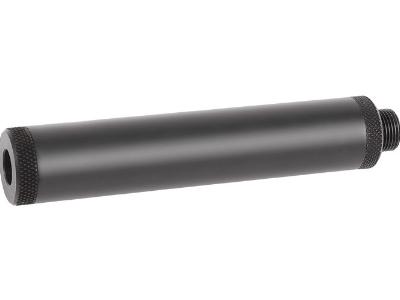
Pilot screw-on silencer
from Advanced Armament, Inc., is one of the most effective separate
.22 rimfire silencers on the market. It drops the sound of a .22
rifle by 41dB.

With the right adapter,
the silencer can be attached to almost any .22. This Ruger Mark
II pistol is quieter than a Crosman Mark II when the silencer
is on.
SO WHAT? We're
talking about airguns here!
Yes we are, and most airgunners know that the Bureau of Alcohol,
Tobacco, Firearms and Explosives (BATFE) has jurisdiction over
firearms ONLY. In fact, U.S. Code specifically prohibits any
federal, state or local municipality from declaring an airgun
to be a firearm. Not only do the federal firearms laws NOT
apply to airguns, they CANNOT be applied by law! But that doesn't
get us out of the woods.
However...
IF you have an airgun silencer, and IF it can
be removed and installed on a firearm, and IF it then quiets
that firearm - that silencer meets the legal definition and is
subject to the law. However, in the United States, a person is
considered innocent until proven guilty, so it is also necessary
to prove intent, as in you intended to use the silencer in
your possession on a firearm. Therein lies the problem.
At this point, I will cut directly
to the chase. When you
are tried for owning an illegal silencer, the federal government
will vigorously prosecute their case against you. A court case
uses a lot of resources, and they don't like to lose. The decision
usually comes down to the judge after both sides have presented
their case. You probably know that there are some judges who see
their duty as interpreting the law, and there are other activist
judges who see their duty as rectifying the current social situation
- "putting things right," as it were. If you happen
to draw the latter kind of judge, the outcome could be devastating. Even if you do happen to win, the time, money and heartache of preparing for a trial isn't pleasant for most people.

Originally, silencers were
for personal comfort and courtesy. This is how Europeans view
them today, but most Europeans do not own firearms.
Image used with permission from FirearmSilencers.com.
When it comes to the question
of airgun silencers, I have a saying I live by, "I don't
want to learn the law while sitting at the defendant's table."
Now, I happen to own a legal silencer, and whatever I do with it
is my business as long as I obey the law. So, I can put my
silencer on a loud airgun to make it quiet, if I want to.
I can also sleep at night.
What about
a moderator?
Shakespeare said it best,
"A rose, by any other name, would smell as sweet." Calling
a silencer a moderator doesn't change the law. Better read
that definition again.
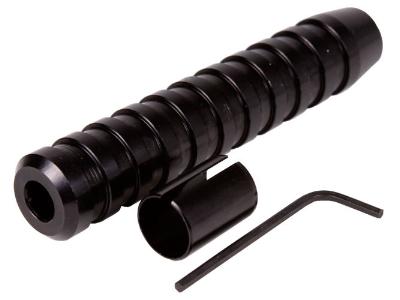
I think some people are confused
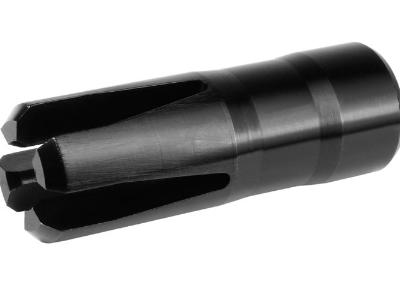
about the difference between a moderator and a compensator.
Moderator is the European term for silencer. A compensator is
a device that also fits on the end of a barrel to do one or two
things. One - it directs gasses away from the tail of a bullet
or pellet, reducing any disturbance to its ballistic flight. Two
- it directs gasses upward to counteract the tendency for the
muzzle to flip up as the bullet leaves. A compensator exists to
improve accuracy, while a moderator/silencer/suppressor/sound
attenuation device (or any other name you can think of) is designed
to quiet the report of a firearm.
What about a silencer that's
permanently attached to the airgun? That's okay, as long as it can't be removed with a carbide cutoff
wheel, a hacksaw or an oxy-acetylene torch.
REALLY?
The truth is I don't know and
neither does anyone else. I merely point out the absurdity of
thinking that something can be permanent.
What about a shrouded barrel?
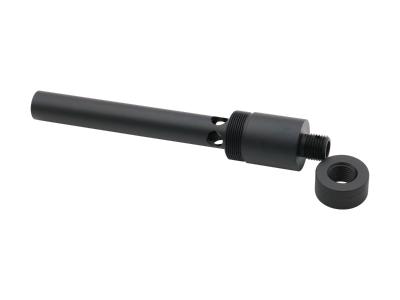
AirForce Airguns was the first to market the
shrouded barrel with their popular Talon SS. The short SS barrel is housed inside the gun's
longer frame, and an end cap strips away the loud noise of the
shot as the pellet passes through. It clearly isn't a silencer
because there is no device involved. However - a number of johnny-come-latelys
are now marketing aftermarket barrel shrouds for guns that didn't
have them originally. Could any of these "devices,"
for that is what they are, be attached to a firearm and diminish
the report? I don't know and, as I said before, I don't intend
finding out the hard way.
Don't there
have to be baffles inside for a device to be considered a silencer?
No more than an airgun
has to operate on air (i.e., CO2 guns). Baffles were in one of
the very first firearm silencers patented by Hiram Maxim in 1909,
but there is no mention of baffles in the legal definition. The
reason everyone talks about baffles is because they are still
an effective way to silence a firearm's report. But baffles
are not required.

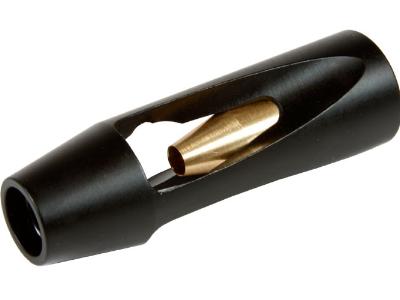
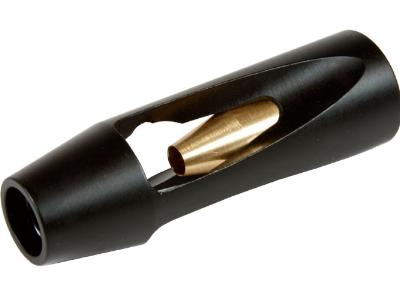
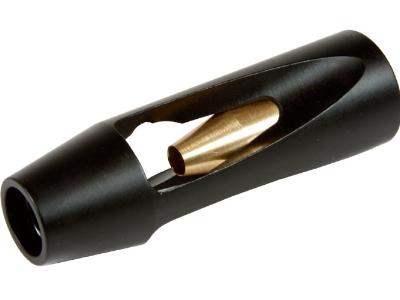
Hiram Maxim's first silencer
was pretty advanced for its time. The baffles were already there
and formed to hold exploding gasses in compartments.
Image used with permission from FirearmSilencers.com.
So, what is
a muzzlebrake?
In the United States,
a muzzlebrake is a swelling at the muzzle of an airgun. On breakbarrels,
it often gives more leverage for cocking. On other types of airguns,
it's decorative. On a .50 BMG, it's a type of compensator that
helps reduce felt recoil. In the United Kingdom, it's a slang
term for moderator, which is their term for a silencer.
Yeah, but will
the government really prosecute?
You can play Russian roulette
with your life if you want to, but leave me out of it. Yes, the
government will prosecute. I know airgunners who have been
arrested and had their silencers confiscated. If the government
can make a case, have no doubt that they will. I know dealers
who have been "visited" by representatives of BATFE
because they were selling airgun silencers. You can joke about
this with your buddies, but when you are seated facing two or
three government agents and forced to have a long, in-depth conversation
on a subject you know only a little about, things come into sharp
focus.
What about
airguns that have real silencers built in from the factory?
1. The TX200 Mk III has a shrouded barrel with
baffles in the end of it. It is clearly a silencer. HOWEVER,
it doesn't do that much for the TX200, because that airgun isn't
loud to begin with, and if someone were to go to the trouble of
cutting the shroud and baffles off a TX200 and mounting it
on a firearm, they would be insane. Why spend over $500 to get
materials you can buy at Home Depot for under $5? Why do WORK
to get them, instead of just buying them as pieces? And, why work
EVEN HARDER to lash them to a firearm, where they would be hopelessly
inefficient because of how they were made and what they were originally
designed to do? If the government hates you that much (to prosecute
such an unworthy case), they can just hire a hit man and be done
with it for far less time and effort.
So, the TX200 with built-in
silencer is okay!
2. George Bigbore handmakes
a .25 caliber air rifle that develops 120 foot-pounds of energy
- the equivalent of a .22 Long Rifle cartridge. George is a rugged individualist who
talks louder when he's disagreed with. He likes "living off
the grid," though he would be surprised to learn that his
lifestyle attracts even more attention and has generated a thick
FBI file. George makes and sells a dozen air rifles each year.
Some of them have parts that could be removed and put on a firearm
to diminish its report. BATFE agents have started their own file
on George, but he is such a minnow that they don't even toss him
into the pan when frying a bigger fish. Time is on their side,
though, and one day old George may cross the line far enough that
the government decides to send a message to the other 437 known
makers of "fringe" silencers. With their thick file,
plus whatever George just did to put himself over the top, it's
showtime!
Your custom high-power super-silent
.25 caliber air rifle made by George Bigbore may have an unregistered
silencer on it. If George
goes down, he may take you with him. Then you can listen to him
complain loudly for hours that the government had it in for him,
as you both mop the floors of cellblock B.
Why doesn't
somebody write to the head of BATFE and request that they make
a ruling about airgun silencers?
It's been done - MANY times. The BATFE has no more authority over
airguns than the government of Australia has over the United States.
Airguns are outside the scope of the Bureau's charter, so they
cannot issue any kind of statement about them. Silencers, on the
other hand, are their bread and butter. So, if a device can
be REMOVED from an airgun and ATTACHED to a portable firearm and
diminish its report, that device is then legally defined as a
silencer. If that silencer has no serial number, it becomes
a firearm without a serial number - the possession of which is
a criminal offense. If you made it, you could be found guilty
of manufacturing a firearm without a license - another criminal
offense. If the judge decides that your legal ownership of a .22
rimfire rifle constitutes the intent to attach your illegal silencer
to a firearm, you could lose everything you own and go to prison.
I can't sum this up any better
than to say I've been summing it up all along. The airgun silencer
issue is complex, convoluted and anything but clear. If someone
tries to convince you otherwise, don't listen to another word
they say.
My thanks to Bob the gunman for
the use of his graphics with this article. Bob owns FirearmSilencers.com, a website dedicated to
educating people about silencers.
|
|